
Settlement for one day (Z-report) or a period of time
You can find both types in Admin > Reports.
Z-report and X-report
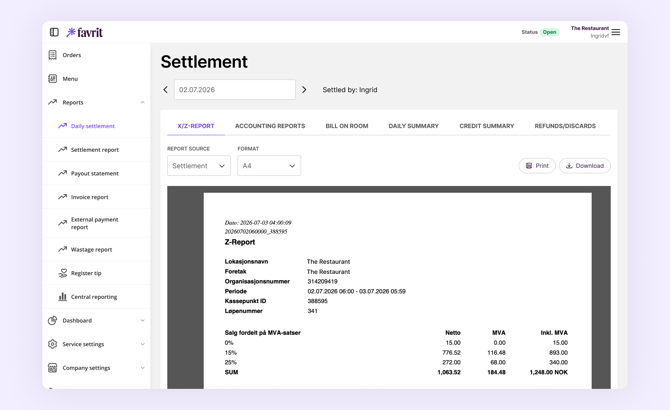
- Z-report can be found under Daily settlement, which shows one specific day at a time. A reporting day runs from 06:00 to 05:59 the next day, local time. The Z-report is generated automatically when the reporting day closes.
- X-report shows the current day so far, before the reporting day closes. You can view it as many times as you like during the day.
- Daily settlement also has additional tabs with other daily reports — see Which reports are available in Favrit? for what each one shows.
For a selected time period
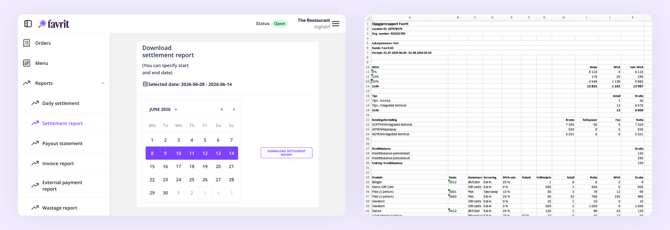
- You can download the Settlement report as an Excel file for a custom date range. It also includes extra tabs with summaries per product, volume sales, account/tax group, and gift cards — see Which reports are available in Favrit? for what each one shows.
Getting the report by email
The report can be sent to you by email every morning. Set the email address that receives it under Admin > Company Settings > Company Profile.
What the fields in the Z-report and Settlement report mean
The Z-report and the Settlement report contain the same fields, so this glossary applies to both. Here is what each section shows.
Report details
The top of the report shows your location name, company, organisation number, the reporting period, and the register (kassepunkt) ID. The Z-report also includes a sequence number (løpenummer) — a legally required running number for each closed day.
Sales by VAT rate
Your sales split by VAT rate, with net sales amount, VAT amount, and gross sales amount for each rate. The SUM line is your total turnover for the period, excluding tips. See also How do tax groups (VAT) work in Favrit?.
Tips
Tips split by how they were received, with the number of tips and the gross amount for each.
Payment processing
One row per payment method, showing:
- Gross — the total amount your guests paid with this method.
- Refunds — amounts refunded to guests.
- Fee — transaction fees deducted by the payment provider (for example card fees on Adyen payments).
- GC-Commission — commission on gift card redemptions, where applicable.
- Net — gross minus refunds, fees, and commission.
Sub-types and SUM rows
Each payment group shows one row per sub-type (for example each card brand). On the Z-report, each group also has a SUM row — if a group only has one sub-type, the two rows show the same amounts. These SUM rows only show on the Z-report, not on the Settlement report.
Unintegrated payments
Rows starting with UNINTEGRATED are payments processed outside Favrit but registered in the system — for example Cash without cash drawer, Wolt/Foodora, an external card terminal, or bill on room. Favrit does not deduct any fee on these, and the money does not come through a Favrit payout.
Note: The net amount here is not the same as what lands in your bank account on a given day — payouts follow their own schedule. See the Payout report article for how payouts work.
Credit balance
Shows your credit balance at the start of the period, at the end of the period, and the change during the period.
The credit balance is the difference between sales and actual payment. If an order is left unpaid — order lines that have not been discarded — that amount is added to the credit balance.
Any change to the order (discount, discard, refund, splitting, or adding new items) is registered in the credit balance on the day the change was made, and paying the order reduces the balance.
For example:
- Monday
- An order of 900 kr is left unpaid.
- The credit balance increases by 900 kr.
- Total balance: 900 kr.
- Tuesday
- An order line of 100 kr is discarded.
- The credit balance decreases by 100 kr.
- Total balance: 800 kr.
- Wednesday
- The order gets a 50% discount.
- The credit balance decreases by 400 kr (50% of 800).
- Total balance: 400 kr.
- Thursday
- The order is paid.
- The credit balance decreases by 400 kr.
- Total balance: 0 kr.
If you are unsure how to handle the change in credit balance in your bookkeeping, please consult your accountant — Favrit cannot advise on how to post entries in your accounts.
Product overview
Every product sold in the period, with account number, quantity, serving type (eat-in or take-away), VAT info, and gross and net amount. A few things to be aware of:
- The same product can appear on several rows. For example, eat-in and take-away sales are listed separately because they have different VAT rates, and each size or added customization gets its own row.
- Negative quantities are refunds or corrections.
- The Settlement report includes extra columns not shown on the Z-report: account name, discount, and article price.
Cash register reconciliation
This section only concerns your physical cash drawer: cash sales, cash refunds, net cash sales, cash tips, deposits, withdrawals, drawer openings, and the net amount that should be in the drawer.
If you do not use a cash drawer, this section shows zeros — that is expected, not missing data.
For how to count and settle your cash drawer, see the Daily Cash Settlement article.
Summary
- Total cash sales — in Norwegian bookkeeping regulations, "cash sales" (kontantsalg) means all sales paid at the time of purchase, regardless of payment method — card, mobile payment, and cash alike. This is why the amount is much higher than your physical cash. Sales on credit are not included.
- Tips and Refunds — totals for the period.
- Discounts — the total value of discounts given in the period, in kroner.- Opening and closing change float — the cash float in the drawer at the start and end of the period.
- Drawer openings — how many times the cash drawer was opened with the "Open" action. Openings from withdrawals or deposits are not counted.
- Sales receipts, copy receipts, and provisional receipts — receipt counts, required by cash register regulations.
- Discards/cancellations/corrections — for the current period and for previous periods.
- Grand totals — running totals for sales, returns, and net since your location was set up in Favrit. These cover the whole lifetime of the location, not the reporting period.